QT 08/03/2026 Sun. Matthew 26 The Unexpected and Surprising Responses of Those Who Claim to Serve God 那些自称侍奉神之人的意外与惊人反应
QT 08/03/2026 Sun. Matthew 26 The Unexpected and Surprising Responses of Those Who Claim to Serve God
READ http://www.esv.org/matthew26
Gospel of Matthew chapter 26 reveals something deeply searching: the greatest opposition to Jesus did not come from pagans or distant unbelievers—but from those who claimed proximity to God.
In one chapter, we see devotion, betrayal, boasting, and religious hostility all surrounding Christ. This chapter forces us to ask: What kind of follower am I?
(1) Precious Commitment at the Leper’s House (Matthew 26:6–13)
At the house of Simon the leper, a woman pours out “an alabaster flask of very expensive ointment” upon Jesus. While others calculated the cost, she expressed worship. While others criticised, she surrendered. While others saw waste, Jesus saw beauty.
Jesus declared: “She has done a beautiful thing to me.” (Matt. 26:10) Her act was:
- Costly – It was expensive.
- Personal – She poured it directly on Him.
- Prophetic – It prepared Him for burial.
- Memorable – Jesus said it would be told wherever the gospel is preached.
Application: True devotion is rarely logical to the world. Worship that costs us something is often criticised. But heaven measures sacrifice differently than earth. Are we offering Jesus leftovers—or lavish love?
(2) Sinister Plan by Judas (Matthew 26:14–16, 47–56)
Immediately after this act of devotion, betrayal enters the scene. Judas Iscariot—one of the Twelve—goes to the chief priests and asks: “What will you give me if I deliver him over to you?” Thirty pieces of silver. The price of a slave. Judas walked with Jesus. Heard His teaching. Saw His miracles. Yet proximity did not produce loyalty. Betrayal often begins quietly—
- A heart that grows cold
- A love that shifts to money
- A soul that pretends while negotiating in secret
He even betrayed Jesus with a kiss—an outward act of affection masking inward rebellion.
Application: It is possible to be close to ministry, close to church, close to Christian language—and still be far from Christ.
(3) Boastful Plan by the Disciples (Matthew 26:30–35, 69–75)
The remaining disciples insisted: “Though they all fall away because of you, I will never fall away.” (v.33) Peter was especially bold. Yet within hours, he denied Jesus three times. The contrast is striking: “Loud promises in safety” versus “Fearful denial under pressure”.
Peter did not plan to fail. But self-confidence without spiritual vigilance leads to collapse. When the rooster crowed, Peter wept bitterly.
Application: Sincerity is not the same as strength. Emotion is not the same as endurance.
Boasting is not the same as faithfulness. We must depend not on our passion—but on God’s sustaining grace.
(4) Vicious Plan by the Religious Leaders (Matthew 26:57–67)
The chief priests and elders—those tasked with guiding Israel spiritually—actively sought false testimony against Jesus. Religion without humility becomes hostility. Leadership without love becomes violence. They:
- Sought false witnesses
- Twisted His words
- Accused Him of blasphemy
- Spit on and struck the Son of God
The irony is staggering: Those who studied Scripture missed the Messiah standing before them.
Application: It is possible to defend religion while opposing God. Spiritual titles do not guarantee spiritual perception.
The Heart of the Chapter: Matthew 26 shows four responses to Jesus:
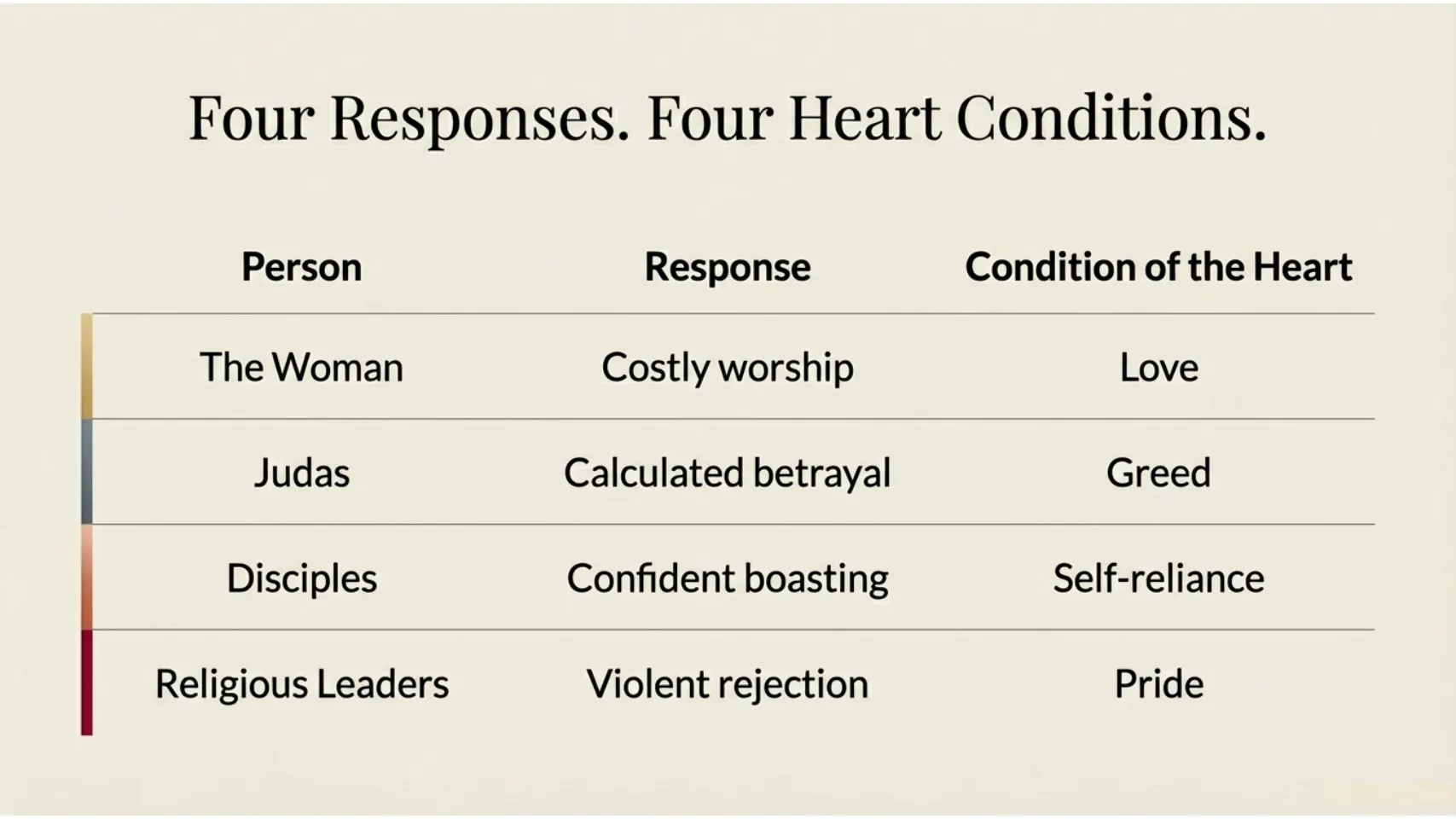
The unexpected truth: Not all who appear devoted are faithful. Not all who speak boldly will stand firmly. Not all religious leaders love God.
Final Reflection: This chapter prepares us for the cross by exposing the human heart. Before we examine Judas, Peter, or the priests, we must examine ourselves.
- Is our devotion costly or convenient?
- Is our loyalty conditional?
- Is our confidence rooted in self?
- Is our religion masking pride?
The beauty of the gospel is this: Even after betrayal, denial, and failure—Jesus still goes to the cross. Grace is greater than our worst moments.
Prayer:
“Heavenly Father, We come before You with humble hearts, knowing that Matthew 26 reveals not only the hearts of others—but our own. Father, we confess that at times we are like the woman with the alabaster jar—we love You deeply and desire to give You our best. Yet at other times, our devotion becomes cautious, calculated, and convenient. Forgive us when our worship costs us little.
Lord, guard us from the path of Judas. Keep our hearts from secret compromise. Protect us from loving money, recognition, or comfort more than we love Christ. Search us and expose any hidden betrayal growing quietly within us. Father, we also confess that we can be like Peter—bold in words but weak under pressure. We promise faithfulness, yet fear silences us. Strengthen us where we are fragile. Teach us to depend not on our confidence, but on Your sustaining grace.
And Lord, deliver us from religious pride. Keep us from outward spirituality that hides inward hardness. Soften our hearts. Make us tender to Your voice. Let us never defend tradition while resisting Your Spirit. Thank You that even in the face of betrayal, denial, and rejection, Jesus chose the cross. Thank You that Your grace is greater than our failure.
Create in us clean hearts, O Father. Make our devotion sincere, our loyalty steadfast, our faith courageous, and our worship costly and beautiful in Your sight. We surrender ourselves again to You. In Jesus’ name, Amen.”
QT 08/03/2026 星期日. 马太福音 26 那些自称侍奉神之人的意外与惊人反应
阅读 http://m.bbintl.org/bible/ncv/mat/26/
马太福音第26章揭示了一个深刻的真相:对耶稣最大的抵挡并非来自外邦人或遥远的未信者——而是来自那些自称亲近神的人。
这一章中,我们目睹了围绕基督的虔诚、背叛、夸耀与宗教敌意。这章经文迫使我们自问:我究竟是怎样的跟随者?
(1) 在痲疯病人家的珍贵奉献(马太福音26:6-13)
在痲疯病人西门的家中,一位妇人将 “一瓶珍贵的香膏” 浇在耶稣身上。众人盘算价值时,她表达敬拜;众人指责时,她全然献上;众人视作浪费时,耶稣却看见美善。
耶稣宣告:“她为我作了一件美事。”(太26:10)此举具有多重意义:
- 代价高昂——珍贵无价
- 亲密无间——直接浇灌于祂身上
- 预示未来——预备祂的安葬
- 铭记于心——耶稣说这故事必传遍传福音的地方。
应用:世人眼中,真正的奉献往往不合逻辑。需要付出代价的敬拜常遭非议。但天上的衡量标准与人间不同。我们献给耶稣的是残羹剩饭——还是丰盛的爱?
(2) 犹大的阴谋(马太福音26:14-16, 47-56)
这份忠诚刚展现,背叛便悄然登场。十二门徒之一的加略人犹大找到祭司长,问道:“如果我把他交给你们,你们愿意给我什么呢?” 三十块银子。奴隶的价钱。犹大曾与耶稣同行,聆听祂的教导,目睹祂的神迹。然而亲近并未铸就忠诚。背叛往往始于无声——
- 心渐冰冷
- 爱心转向金钱
- 灵魂假意顺从,暗中却暗渡陈仓
他竟以亲吻出卖耶稣——表面亲昵掩盖内心的叛逆。
应用:人可能亲近事工,亲近教会,亲近基督徒的言语——却仍远离基督。
(3) 门徒的狂妄计划(马太福音26:30-35, 69-75)
其余门徒坚称:“就算所有的人都因你的缘故后退,我却永不后退。” (第33节)彼得尤为狂妄。然而数小时后,他竟三次否认耶稣。对比何其鲜明:“安逸时的豪言壮语” 与 “压力下的恐惧背弃”。
彼得并非有意失败。但缺乏属灵警醒的自信终将导致崩溃。当鸡鸣三声时,彼得痛哭流涕。
应用:真诚不等于力量,激情不等于坚韧,夸口不等于忠心。我们不可倚靠自己的热忱,唯靠上帝持守的恩典。
(4) 宗教领袖的阴险计谋(马太福音26:57-67)
祭司长和长老——那些肩负引导以色列灵性重任的人——竟主动搜集诬陷耶稣的假证词。失去谦卑的宗教终成敌意,缺乏仁爱的领导终酿暴力。他们:
- 搜罗假见证人
- 歪曲祂的言语
- 控告祂亵渎神明
- 向神的儿子吐唾沫并殴打祂
讽刺令人震惊:研读圣经之人竟错过了站在眼前的弥赛亚。
应用:捍卫宗教却反对上帝是可能的。属灵头衔无法保证属灵洞察力。
章节核心:马太福音26章展现了四种对耶稣的反应:
人物/群体 | 反应 | 心灵状态
妇人 | 珍贵敬拜 | 爱
犹大 | 算计背叛 | 贪婪
门徒 | 自信夸耀 | 倚靠己力
宗教领袖 | 暴力拒绝 | 骄傲自大
出人意料的真相:并非所有看似虔诚者皆忠信。并非所有豪言壮语者都能站立得稳。并非所有宗教领袖都爱上帝。
终极反思:本章通过揭露人心,为我们预备面对十字架。在审视犹大、彼得或祭司之前,我们必须先省察自己。
- 我们的虔诚是代价高昂还是便利可得?
- 我们的忠诚是否附带条件?
- 我们的信心是否植根于自我?
- 我们的宗教是否掩盖了骄傲?
福音之美在于:纵使经历背叛、否认与失败——耶稣仍走向十字架。恩典远胜于我们最黑暗的时刻。
祷告:
"天父,我们怀着谦卑的心来到你面前,深知《马太福音》第26章不仅揭示了他人内心,更映照出我们自己的心。父啊,我们承认有时如同那拿香膏的妇人——深爱祢并愿献上至宝。但有时我们的奉献却变得谨慎、算计、随遇而安。求祢赦免我们那代价微薄的敬拜。
主啊,求祢保守我们不走犹大的路。使我们心不暗藏妥协。求祢保护我们,免得我们爱钱财、爱名声、爱安逸胜过爱基督。求祢察验我们,揭露我们内心悄然滋长的背叛。天父,我们也承认自己有时像彼得——言语刚强,压力之下却软弱。我们承诺忠心,恐惧却使我们沉默。求祢坚固我们脆弱之处,教导我们不倚靠自己的信心,唯靠祢持守的恩典。
主啊,求祢救我们脱离宗教的骄傲。免我们以外在属灵掩盖内里刚硬。软化我们心肠,使我们对祢的声音敏感。求祢使我们永不为捍卫传统而抗拒圣灵。感谢祢,纵使面对背叛、否认与弃绝,耶稣仍选择十字架。感谢祢的恩典胜过我们的失败。
父啊,求祢在我们里面创造清洁的心。使我们的敬虔真诚,忠诚坚定,信心勇敢,敬拜在祢眼中宝贵而美好。我们再次将自己献给祢。奉耶稣的名祈求,阿们。”